

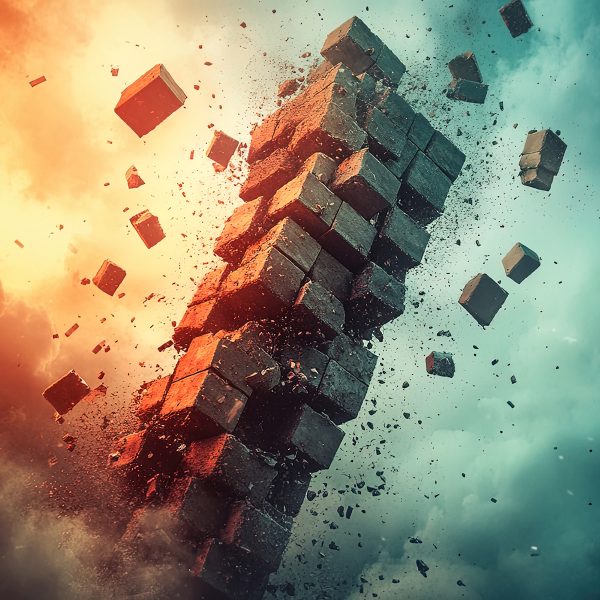
IMAGINE YOU LIVE in a huge container, and because it’s immense and its walls are invisible, most of the time you have no clue you’re in one. Like water to fish—it’s just life.
But it is a container, and it’s vitally important to understand that. Why? Because unless you do, you won’t be able to imagine alternatives. Perhaps even other possible containers.
We’re all in this invisibly enclosed space together—you’re not here by yourself. Let’s call it the IP container. We’ll explain why later.
The IP is old; it’s been in place for centuries, and if you could see this structure, you’d realize how worn out it looks. But you can’t. The walls are thick, except where they aren’t, and they hold everything intact. They’ve weakened in places, and there are some holes; if we knew how, we could look through them at what’s outside. But we don’t even know they’re there. So imagine this is our home—we all live here—and it’s a complex place with certain characteristics.
For example, life inside the IP is guided by a set of rules and assumptions, some obvious, others implicit. We’ll describe some important ones.
To start, there are a zillion things in here (we’ll consider people as some of those things), and the inherent value of each thing depends on who or what it is. Most things are composed of smaller parts. The identity of each individual thing is what’s important. Each one stands alone in this system. One critical assumption in the IP is that figuring out the identity of every part of each thing leads to understanding the thing itself.
The IP is a colossal system, and each thing in it is a particle belonging to that system, which is why its rules apply to every separate thing. Since things are separate, rules are needed to hold everything together. If and when people stop following them, groups will become disconnected. “Separate” is an important word, since this is a fragmented world in which all things are discrete. A particle’s identity is needed to distinguish it from the other separate particles.
But in this world, the particles aren’t simply scattered willy-nilly all over the place; they’re organized into various structures of different kinds. Some are physical, some are organizational; most of the organizations are hierarchical. Schools, businesses, and governments exist, and they’re all hierarchically structured with a top-down flow.
Hierarchy becomes imprinted in the brains of everyone in the IP as the dominant and most natural way to structure things. Therefore, it gets applied widely. For example, it seems natural to assume that racial differences should be ranked hierarchically, and for white people, it also seems obvious that whites are at the top, Black people are at the bottom, and Asians of various types are floating around in the middle. Class differences, and in fact, all human differences, are seen that same way. And the prevalence of hierarchies also suggests that humans rank at the top of all living species. As such, they can do what they want with all the other species and the entire planet. They dominate everything, which is easier to do because they are seen as separate from everything.
Because of this separateness, all individual things in the IP get compared and contrasted with other similar things, again, with a ranking mindset. How are they different? Which is bigger or smaller, better or worse, faster or slower, smarter or dumber? Which is the best? The IP is rife with comparisons and either/or thinking.
In such a container, the most logical way to assess the world is by using the process of analysis. In analysis, you take a complex “thing” apart so you can study its smaller, more manageable parts, eventually getting to the smallest unit. When you’ve studied all the parts, you should be able to understand the entire thing. We do a lot of analyzing in the IP: we have data analysis, qualitative analysis, quantitative analysis, inferential analysis, cohort analysis, and sentiment analysis. Analytical thinking is endemic here.
Life in this container can be comfortable at times because order and stability are prized. When an individual’s identity—its nature—is most important, action isn’t at the forefront in the quest for understanding. It’s happening, of course, and we notice and talk about it. We try to understand it, but our tools for understanding action are limited, and we spend more time trying to figure out the nature of things. What is a molecule? What are its parts? (They’re composed of atoms held together by chemical bonds in various shapes.) What shapes? What are atoms made of? (Protons, neutrons, and electrons.) OK, now we understand matter better. Long ago, people had no idea that a tabletop, for example, or a rock, or a grain of corn—everything—was composed of smaller and smaller units. Now we know.
Such information gives us a comfortable sense of knowing our world better. It’s a stable world insofar as molecules will continue to be composed of atoms, and the makeup of atoms won’t change. We have the sense that our world is predictable, another source of comfort. And we seek comfort. Unfortunately, stability can devolve into rigidity. Some people want to hunker down in the past, where things have already happened and can’t change, even at times to the extreme. Can you believe there is still a “Flat Earth Society?”
It makes sense in the IP, with all its other attributes, to view an event narrowly. To strip it down to its essential elements so we can understand it better. That’s one reason we have scientific laboratories. We take a soil sample and send it to the laboratory for analysis. Analysts break the soil down into all its components and determine which elements need to be counterbalanced or eliminated, and which additional elements need to be added to make it fertile. Or, thinking of a human example, a child fails a class. That’s the event. The child failed. To figure out why, we look at the teacher, the child, the material being presented, and maybe the classroom. From analyzing those essential elements of the event, we draw our conclusions. If we find that the child failed because they weren’t paying attention, we try to find ways to fix their attention on schoolwork. If we determine the teacher wasn’t skilled, we try to remedy that. In the IP, we’re encouraged to use a narrowly focused, direct view that excludes extraneous data, gets rid of the clutter, and gives us a cleaner, purer view of the situation.
In the IP world of separate things, it’s natural to compare and contrast them. As we compare and contrast ourselves with others, progress becomes a top-ranking value, and the world comes to be seen as a competitive arena. Over time, in each sector of this system—education, medicine, the law, science, etc.—more and more people race for the top. They know that “if you’re not going up, you’re going down,” as they say in higher education regarding a school’s ranking with its peers. Either/or thinking tells us that you progress or you regress, and of course you want to progress. You want to get bigger, better, wealthier, and more powerful. Continual progress is a ubiquitous goal in the IP.
Summing up, people living in the IP container share certain assumptions. They believe their view of reality is reliable and that their world is stable. Theirs is a physical world in which matter is composed of smaller and smaller separate parts. When they try to understand a “thing,” they take it apart and try to identify its parts. Using analysis, they strip away anything unessential to get a clear, pure view of something—analysis has become their major method of inquiry, just as either/or thinking is their standard method of appraisal. Hierarchies abound in the IP: this type of structure seems naturally dominant. In a fragmented, hierarchical world, progress is the goal, for individuals, organizations, and even nations. The race is to the top.
BUT
What if the IP is not the only container people can live in? Another exists that is guided by a very different worldview. We’ll call it the RP. It came into being when people ceased to rely on the IP’s assumptions and started using scientific tools to create a new and different view of reality, one that couldn’t be more different from the IP’s.
Even its structure is different. It’s not so rigidly configured: its walls are expansive, porous, and flexible because they have to be. (And now that there are two containers, the walls of both have become visible to those living in the new one.) Inside this new container, movement is everywhere, in all directions: so much movement you’re forced to focus on it. It seems alive in here. Nothing is static, nothing is root-bound. What a lot of energy!
Rules are beginning to emerge in this environment; they’re open to change depending on what’s going on. They’re adaptable and responsive. Rules are not as important in the RP as they are in the IP. In the RP system, what stands out are the interconnections among all the things or particles that are dancing about. “Connection” is a very important word. In this world of constant change, what things are doing and how they’re connected with others is paramount, and identities are of secondary importance. The interconnections are one of the reasons rules are less important here. In the IP, if the rules break down, everything will become more fragmented, but the RP is not a fragmented world to start with.
Even amid the constant change, structures exist, sometimes temporary, often created in response to what’s happening. Some are hierarchical, but hierarchies are often softened by ancillary, flatter structures, where participants are connected horizontally. Even when hierarchies function as they are, energy and information flow in multiple directions. For example, in some RP corporations, people in top positions consult widely with relevant groups of people in lower-ranking positions before making important decisions, and in others, the hierarchical positions remain constant, but different people occupy them for certain periods of time. In those companies, periodic rotations bring fresh thinking and creativity.
Structures influence thinking in any environment. Here in the RP, with interconnections in the limelight, synthesis becomes an approach as important as analysis in planning and problem-solving. In fact, the two are mutual handmaidens. Synthesis is the process of combining ideas, units, or components in ways that create something entirely new. It’s a highly generative process. After taking something apart using analysis, one can try assembling all the parts creatively into something that couldn’t be predicted earlier. The creativity of this process is aligned with the energy found everywhere in the RP.
The flatter physical and organizational structures that are found here suggest an assumption that human differences exist on the same plane. No one has greater or lesser status based on race, religion, sex, gender, etc. These are seen as simply random differences that are valuable because they help shape different points of view, which leads to more creative thinking.
As you recall, in the IP, people wanted to see an event in its simplest form, apart from extraneous data—a narrow, direct view. In the RP, people understand that context applies to any situation and usually adds essential information that leads to solutions. Examining context is one of the most important markers of this worldview. If we revisit the examples from the IP, analyzing the soil sample and helping the failing child, we can see that taking context into consideration may change everything. The soil in question may be from a brownfield, information that would be critical, or it may be close enough to one, or to another source of pollution, that any attempt to suggest remedies to the soil would fail if its context were ignored. And as for the failing child, a wise counselor would want to know what is going on in the child’s home and life. Did someone close recently die? Is the family being evicted? Any traumatic event could be the causative factor in the child’s failure, and children are not likely to divulge such information. They may not even know how to. Context. Ignore it at your peril.
Which leads us to “either/or” thinking, an approach that works well when everything is separate. Here in the RP, where change is constant, “both/and” thinking is more helpful. “Both/and” helps keep your mind open to whatever comes next. It’s more suited to this environment because of its flexibility. It welcomes new information.
Let’s consider the comfort of stability. Yes, routines and repeated events, seasons that occur annually, and anything that can be reliably anticipated make life easier. In a chaotic world, these anchors are fewer. In our world today, with climate change rearranging our seasons and governmental officials behaving as if no laws or legal precedents apply to them, our ability to predict what’s coming next based on past events is greatly diminished. In a chaotic, complex world, such as we’re getting used to inhabiting, we’ll be more successful if we are open to change and only lightly tethered to expectations and assumptions. That allows us to be nimble and creative in response to unanticipated events. We will spend less time in shock and more time in analysis and synthesis as we confront the unimaginable.
The RP environment is suited to this type of world because of the attention it pays to interconnections and action. After all, if you rely on your assessment of someone’s identity based on past performance, you may be knocked out of whack when their current actions take a totally different direction. But if you pay attention to the web of connections surrounding that person and the patterns in their past behavior while remaining open to any possible future actions, you’ll be well prepared for whatever takes place.
Finally, what about the guiding principle of progress? Progress is a linear notion. When you progress, you are typically moving from one point to another, usually from a lower to a higher point. It may not be a smooth line, but the overall direction is up. In the RP, the word “progress” may take on new meanings. Perhaps it means that you deepen your understanding, digging down through the archaeological layers of your mind and the minds of others. Or it could mean that your thinking spreads out in many directions through your contact with others. And when collaboration and cooperation become bywords in a society, the idea of progress becomes nuanced with the assumption that one’s actions are collective rather than singular.
NOW,
It’s time to draw the veil aside. These containers, while not at all physical, are real. The old IP is the industrial paradigm, and the RP is the newer relationship paradigm. A paradigm is a standard way of thinking about the world or an academic field that incorporates a set of assumptions describing that view. The assumptions dovetail together: the view is coherent and stable.
Most people in the twenty-first century share most of the industrial paradigm’s assumptions about the world they live in. Unfortunately, these assumptions lead to behaviors that now threaten the existence of all living systems. Highly valuing individual progress in a competitive environment leads to a lust for money and power, and people will do whatever it takes to rise to the top of the pyramid, no matter the cost—even if the cost is the destruction of all living systems as we know them.
Here are some questions for you. Which container world are you drawn to? If you would prefer to live in the relationship paradigm, what are you willing to do to promote its values? We are teetering on the edge of a precipice. Unless more people learn about these two containers and choose to help boost a cooperative, collaborative world as the highest value worldwide, we may move past the point in time when doing so is even possible.
We leave you with these thoughts. If you’d like to engage in a conversation about these two containers, please contact us through our website at www.chaosinstitute.org.